InfoCaption in action
Help employees find their way in the maze of knowledge
Åmål municipality simplifies its employees' working day by mapping tasks and areas of responsibility in processes. So that everyone finds knowledge.
In most businesses, there are a variety of routines aimed at ensuring quality and supporting employees throughout the working day. However, there is often a lack of guidance on how to create and share these routines efficiently and with a good user experience. By spending time creating conditions and guidelines for creating routines, the business has a lot to gain.
Often, routines are created at different times, by different people, and for different purposes. If there are no guidelines on how these should be formed and shared, it is also natural that there is a lack of uniformity in their handling, which leads to uncertainty for the person who is to create and read the routine. If routines are to be widely shared in the business, we usually recommend that, at least to some extent, the routine's layout be adjusted. It will streamline the creation process and make it easier for the employee to find information, as it is presented consistently regardless of subject or author. If you also add a graphic layer with recurring colours and shapes, it contributes to recognition and a sense of security in the material the end user is looking for.
If an important part is to find the routine, then, of course, another important part is to find the routine. In this context, we usually raise the concept of Single point of truth - which, in short, means that there must be a place where you know you can find the "truth," i.e., the most relevant and most recently updated routines. If there is no clear Single point of truth, it will mean unnecessary time is spent looking for the right routines, and employees lean towards outdated routines, thus reducing execution quality.
Following routines can have different importance, but if you work in banking, it's not something you joke about. Because many tasks are complex, you have legal requirements to handle and follow routines correctly. Due to this, Länsförsäkringar has taken a serious approach to how it can effectively create and share routines within the business. Below, we can read more about Länsförsäkringar's journey toward a more efficient creation process.
This is what Cassandra Isgren, Business Developer at Länsförsäkringar Bank, says about their work:
"The background to the work to create a portal and template for our routines is based on the fact that we previously used an overview (manual), which was difficult to keep track of, given that we had more than 200 routines. Employees pulled together to create new routines because it was difficult to understand the structure we set up, with the overview and categorisation not coming naturally. In the work, we had two goals: to make it easier to create routines for those who work with the tool, and to make it more user-friendly for those who will absorb the information. Hence, the work landed in a portal where we built a widget for each unit within the Bank. Subsequently, sub-portals were created for each unit, where we have now collected routines, manuals, and information specific to each unit. This has created a better user experience for our users because we refreshed it with images, easier ways to search for the material, and, most importantly, the ability to see the most-viewed guides and their favourites directly in the portal. A big plus for our users is that they can now easily see when a routine is updated via a widget. We have also built a communication tool into our sub-portals, which is much appreciated. When we make major changes to the routines/manuals (guides), we post a news update that informs users about the changes and what's been updated, with an invitation to read the routines. In this way, we believe that we will generate more value for our users and make them aware of when they need to update themselves on a routine basis.
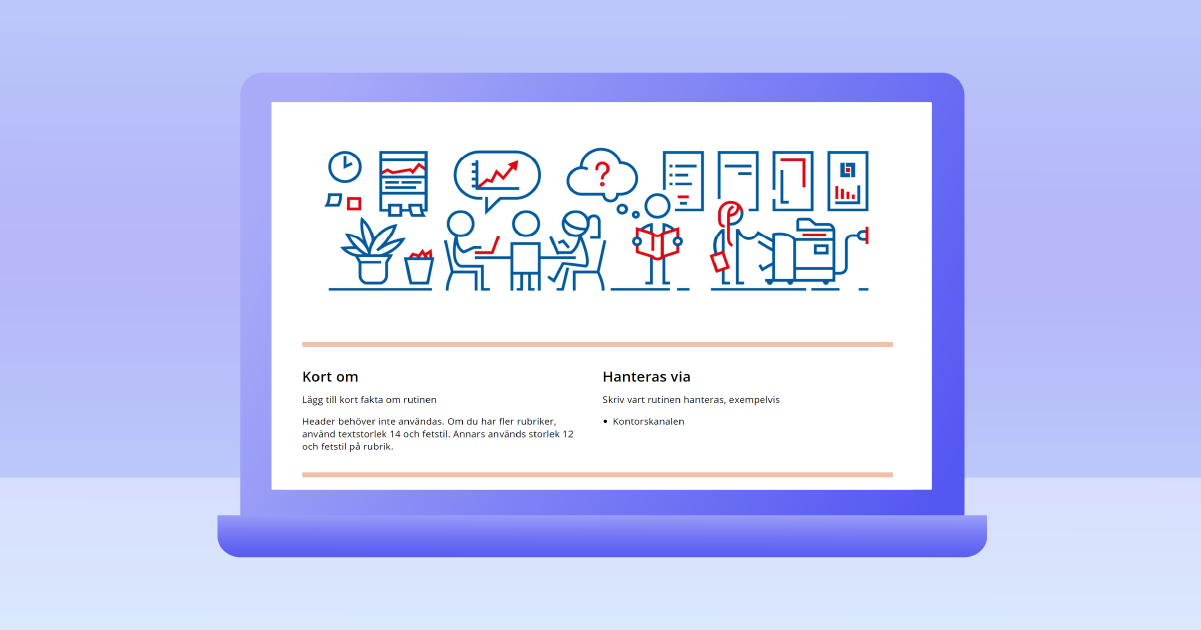
As for us who work with the tool, we also needed to create something that supports our work. The result was an example template with clear instructions on which headings, images, and fonts to use. This facilitates our work and makes it easy and also fun to create a new routine because you have the support you need. We have also produced a routine description for internal use that explains the various sections of the routine and outlines the functionality they fulfil for end users.
In summary, we needed to create a simpler everyday life where our work in Infocaption became easier for us as users of the platform but also create a fresher end product for the end users, which we think we have succeeded in, and the end users seem to agree with us as the feedback has been very nice with cheers and encouraging words both linked to the portal and the routines."
 Click here to see the template that Länsförsäkringar reuses for its routines (in Swedish)
Every month, we at InfoCaption appoint the Guide of the Month - a guide that we want to highlight a little extra because of the value it creates in the organisation. As a thank you to the person(s) who created the Guide of the Month, we donate SEK 1,000 monthly to Hand in Hand Sweden, which fights poverty by creating more jobs in vulnerable countries. Hand in Hand works with the "help to self-help" model, which is in line with InfoCaption's own mission", to make it easier for employees to help each other."
We in the InfoCaption team believe that Länsförsäkringar's work to create conditions for simplicity through reusable templates and searchable portals is fully aligned with our mission. We believe that is worth celebrating.

Åmål municipality simplifies its employees' working day by mapping tasks and areas of responsibility in processes. So that everyone finds knowledge.
Mark's municipality has created an InfoCaption training course about their personnel system that saves time and resources.
Kammarkollegiet helps its employees find the right information through guides that are shared through strategically placed QR codes.