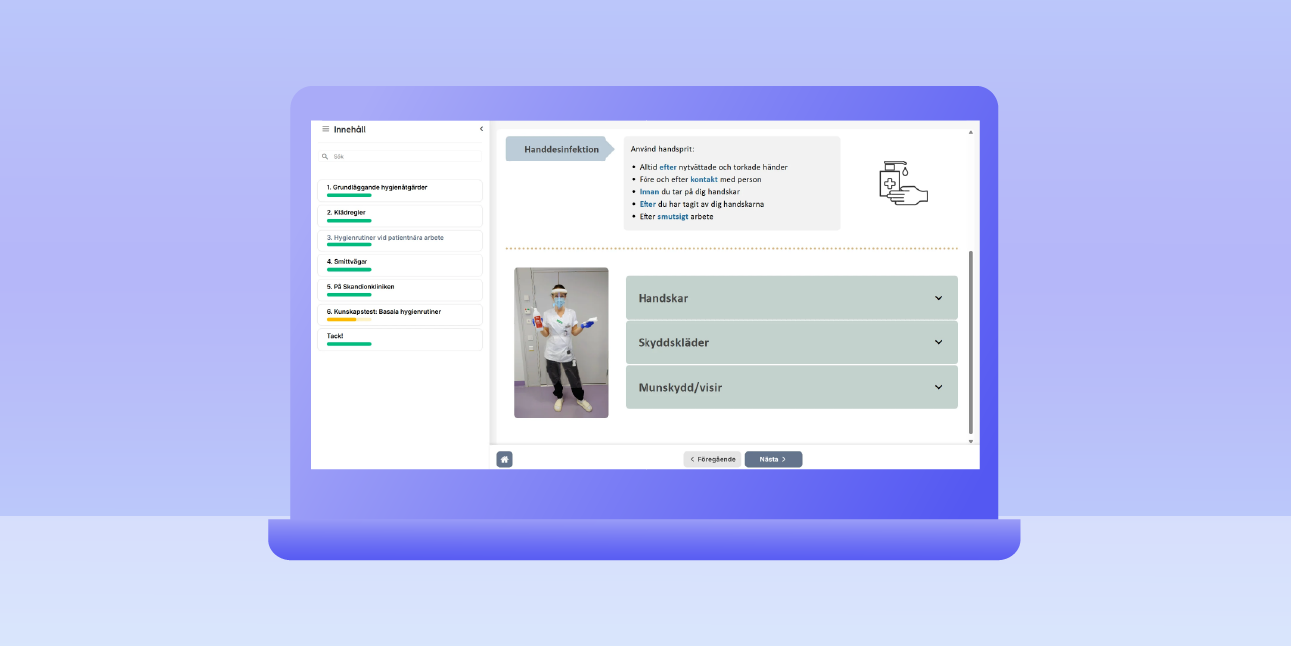
Some training courses cannot be opted out of. Basic hygiene procedures are one such example. At the same time, it is easy for compulsory training to become something you simply have to get through, particularly when the same course has to be completed several times during your employment.
Skandionkliniken has found an effective way to make the training both clear and relevant to its own operations. That is why their training in basic hygiene procedures has been awarded the 'Guide of the Month' accolade.
Training tailored to Skandionkliniken’s reality
Skandionkliniken is jointly owned by seven regions and offers proton beam therapy to cancer patients from across the country. For an organisation where many patients are severely affected by their illness, preventive hygiene work becomes a vital part of day-to-day operations.
The training is compulsory for everyone working in direct contact with patients at the clinic and must be completed every three years. This places slightly different demands on the training than if it were to be carried out only once.
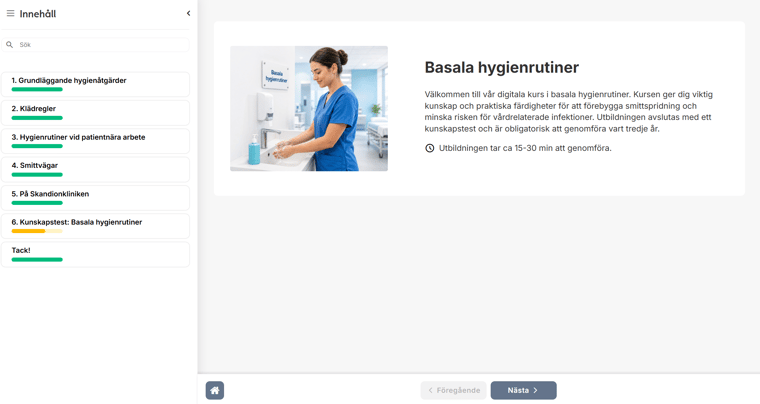
It needs to be comprehensive enough to cover what staff need to know, whilst at the same time being straightforward to work through and easy to refer back to. This is evident right from the home page. Staff are immediately informed of what the training is about, why it is important, and roughly how long it takes.
A clear structure from basics to practical application
The training is divided into six parts:
- Basic hygiene measures
- Dress code
- Hygiene procedures for patient-facing work
- Routes of transmission
- At Skandionkliniken
- Knowledge test: Basic hygiene procedures
It is a simple structure, but it greatly enhances the training, as staff can always see where they are in the process and what remains to be done, whilst the content follows a natural sequence: first the basics, then more specific sections on clothing, patient-facing work, etiquette and routes of transmission, and finally a shift from the general rules to their own workplace, before a knowledge test brings everything together.
In this way, the training becomes more than just a collection of information about hygiene procedures. It builds, step by step, towards applying this knowledge in practice.
Clear rules, but also the opportunity to learn more
Each section begins with a brief explanation of why the rules exist, followed by the specific hygiene procedures, such as hand hygiene, clothing, and personal protective equipment. One feature that works particularly well is the link to Skandionkliniken’s own policy documents in RMT+: whenever there is further information or a document that forms the basis for the content, the training course links directly to it, so that staff never have to search for the right document themselves.
Those who wish to delve deeper can therefore do so, whilst those who primarily need to work through the training itself can stick to the content provided there. It is a fairly simple solution, but ensures that the training can cater to different needs.
When the general becomes specific
What perhaps stands out most, however, is the section ‘At Skandionkliniken’, where the training moves away from general hygiene procedures and instead links the content to the organisation’s own operations. This is an important distinction: reading about the rules that apply in general is one thing, but seeing how they should actually be applied where you work is another, and it is precisely this connection that we often find valuable when we look at how our customers use InfoCaption. General information simply becomes more relevant when placed in a context that the employee recognises.
For Skandionkliniken, this means that the training doesn't stop at what to do, but also shows how hygiene procedures tie in with their own day-to-day work.
“The training complements our standard hygiene routines and is carried out regularly by staff who administer radiotherapy to the clinic’s patients. The response has been positive, and the most important outcome is that the training serves as a reminder of the importance of consistently following hygiene procedures, as this reduces the risk of spreading infection,” says Emelie Hedlund, receptionist and guide producer at Skandionkliniken.
Concludes with a knowledge test
After the five sections, the training concludes with a knowledge test on basic hygiene procedures, which provides a natural conclusion and gives staff the opportunity to check that the content has actually been retained. All in all, it is the combination of elements that makes the training course interesting: it is relatively short, has a clear structure, and blends information, sources, video, and work-related content. It doesn’t need to be any more complicated than that.
Compulsory training needn’t simply be a formality to be ticked off a list. With the right approach, it can also serve as practical support for staff and a way of keeping vital knowledge alive over time, and it is precisely this insight that makes Skandionkliniken's approach worth drawing inspiration from, regardless of sector. Any organisation with recurring compulsory training programmes – whether it’s fire safety, data protection or any other area where knowledge needs to be kept up to date – can follow the same approach: a clear structure, a mix of formats and a link to their own business. That is the difference between a training course that is simply ticked off the list and one that actually sticks.
Skandionkliniken wins the ‘Guide of the Month’ award
Every month, we at InfoCaption select the ‘Guide of the Month’ – a guide we want to give some extra attention to because of the value it brings to the organisation. As a thank you to the person or people who have created the ‘Guide of the Month’, we donate 1,000 SEK every month to the organisation Hand in Hand Sweden, which combats poverty by creating more jobs in vulnerable countries. Hand in Hand works on the ‘help people to help themselves’ model, which is in line with InfoCaption’s own mission to make it easier for colleagues to help one another.
Let the knowledge stick, don’t just tick it off: