Business development
5 Signs Your Business Needs a Centralised Information Platform
Minska tidsspillan och förbättra effektiviteten med en central informationsplattform. Läs om fördelarna för din organisation.
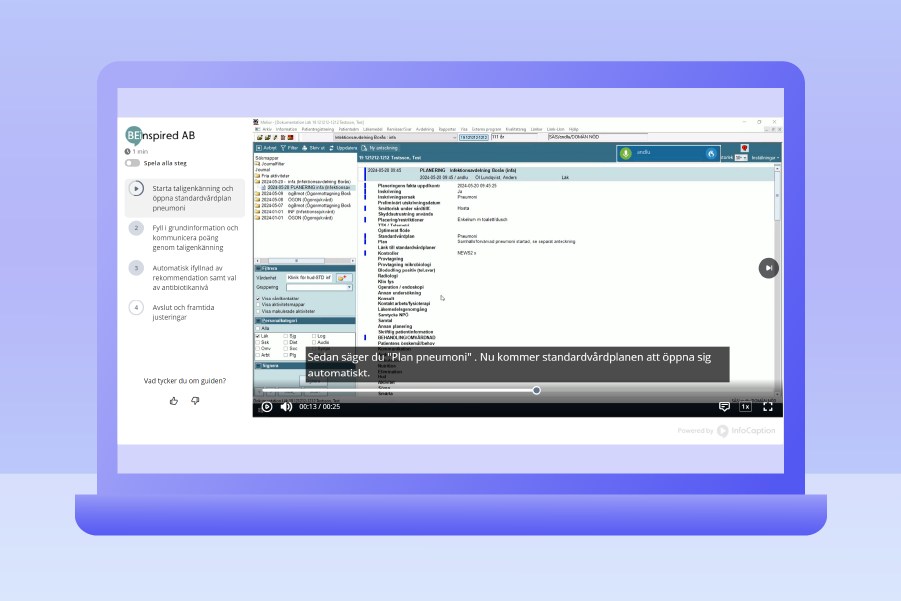
Change and development happen everywhere and all the time. New smart solutions replace each other. But how do you ensure that the new solutions are used in an organisation so that you actually reach the potential?
The Västra Götaland region (VGR) has, as part of the national knowledge management, a process organisation to improve the quality of care. Anders Lundqvist, infectious disease doctor at Södra Älvsborg Hospital, leads one of the processes and is responsible for the quality of care for patients with pneumonia, which includes more than 7,000 care opportunities per year in VGR. One of the main goals of the improvement work is to optimise antibiotic use.
The process work has been ongoing regionally for five years, and the improvement work takes place through a combination of guidelines, information, feedback and improved digital aids. Since 2023, VGR's medical record system has included a standard care plan that doctors must follow for every treatment. The plan must be followed to achieve the desired quality improvements, but it also means more administration, which can be time-consuming for a heavily burdened healthcare staff.
To simplify implementation, the speech recognition function has recently been implemented directly in the system. This means that doctors can use short code words to automatically perform tasks and documentation in accordance with the care plan. Anders believes, however, that no matter how straightforward a process is or what advantages a new digital solution offers, changes most often entail a threshold for employees who have to learn new ways of working. Unfortunately, the risk is that the potential is not achieved in the improved processes or new functions.
With a background in this, Anders has focused on providing clear, recurring, stripped-down information on how the specific speech recognition function works. In InfoCaption, he recorded a short video in four steps, totalling 2 minutes, to ensure the message got out and was manageable. The video shows the system view and how the employee can use the function step by step in the process. The video also has audio and subtitles to strengthen the message and increase accessibility.
Anders points out that his favourite is simplicity for the recipient when he creates guides in InfoCaption. If there is too much and too complicated information, his experience is that you risk losing many people. It is better to aim to convey the most important thing!
The video guide has been introduced at one hospital in the region, but it will be introduced at several hospitals in the future. The recipients are primarily doctors responsible for patients with pneumonia, but the guide will also be communicated to managers.
"From acorns grow great oaks," and Anders hopes that the guide can lead to increased use of the speech recognition function and, thus, positive results in the quality of work. Ultimately, the goal is high-quality care for patients with pneumonia, including optimised antibiotic use.
Link to the VGR's video guide in steps that describe the function
VGR's work highlights the importance of clear instructions and guidance when introducing new system functions. Through its educational guide, VGR shows how to discover the actual potential of new functions. For that effort, they are well deserving of the Guide of the Month award – congratulations, VGR!
Every month, we at InfoCaption appoint the Guide of the Month - a guide that we want to highlight a little extra because of the value it creates in the organisation. As a thank you to the person(s) who created the Guide of the Month, we donate SEK 1,000 to the organisation Hand in Hand Sweden, which fights poverty by creating more jobs in vulnerable countries. Hand in Hand works with the "help to self-help" model, which aligns with InfoCaption's mission "to make it easier for employees to help each other".

Minska tidsspillan och förbättra effektiviteten med en central informationsplattform. Läs om fördelarna för din organisation.
QR-koder används flitigt idag, i alla åldersgrupper. Använd QR-koder på arbetsplatsen för att effektivisera och förenkla arbetsdagen. 10 tips på...
Lärande bör inte enbart begränsas till kurser och utbildningstillfällen, utan behöver också finnas tillgängligt i arbetsdagen. Läs mer om push...