Onboarding that continues beyond the first week
Give new employees the right knowledge from day one, with continued support when questions arise. With InfoCaption, you can bring onboarding courses, guides and routines together in one platform, so employees feel confident and get up to speed faster.

Why digital onboarding?
Digital onboarding means making the introduction of new employees structured, accessible and easy to follow with the help of digital tools. It reduces dependence on individual meetings, scattered documents and verbal handovers.
-
Structured and accessible
The right information in the right order, regardless of role, team or workplace. - More than an induction day
Courses, procedures, guides and support materials help new employees settle into their role, organisation and ways of working. - Knowledge that remains available
Support remains available after the initial introduction, so employees can return to it when questions arise in everyday work. - More time for the human connection
Digital onboarding does not replace personal meetings. It creates more time for them.
WEBINAR
Get practical tips for developing your onboarding process
Onboarding is a critical process
Three reasons why onboarding deserves more attention.

Organisations with strong onboarding achieve 82% better retention of new employees.
Source: Brandon Hall Group
Strong onboarding from the start
Strong onboarding increases the chance that new employees stay longer and reduces the risk of costly staff turnover.
With InfoCaption
New employees receive a structured introduction with easy-to-find courses, guides and support. Managers can track progress and follow up when needed. When the introduction is complete and questions arise in everyday work, the support is still available.

Only 12% of employees think their organisation does a really good job with onboarding.
Source: Gallup
Structure where it is lacking
Most organisations have significant room to improve their onboarding. Onboarding requires more than an induction day, a welcome pack or a week of training and meetings.
With InfoCaption
With InfoCaption, you can create a structured onboarding process that can be followed up and improved over time. New employees are introduced to the organisation, understand their role and learn how tasks are carried out in practice.

On average, it takes 6–7 months for a new employee to feel comfortable in their role.
Source: Insight Global
Support beyond the first days
It takes time to become confident in a new role, workplace and set of tasks. That is why onboarding needs to continue beyond the first days of induction.
With InfoCaption
With InfoCaption, onboarding becomes a coherent process with preboarding, induction courses and day-to-day support. Guides and routines remain available when employees need them in everyday work, and new content can be added as they become ready for it.
Onboarding works best over time
When too much information is shared at once, it becomes difficult to take everything in.
Onboarding works best as a process, with clear steps, repetition and support along the way.
Preboarding
Give new employees access to induction material before their first day. This creates confidence and reduces information overload on day one.
- Welcome letter and practical information
- Organisation overview and culture
- Self-paced preparation guides
Structured
Combine structured learning with practical guidance. Induction courses with progress tracking can be complemented with guides that show how tasks are carried out in practice.
- Induction courses with progress tracking
- Guides linked to specific tasks
-
Role-specific information
Everyday support
Keep knowledge available after the induction. When questions arise, support is easy to find in systems, searchable portals and digital guides.
- Step-by-step guides for common tasks
- Searchable knowledge bank
- Manuals and procedures
InfoCaption brings the entire onboarding journey together in one platform, from preboarding to everyday support.
Traditional onboarding provides knowledge once, at the beginning. InfoCaption makes knowledge available before, during and after the onboarding.
More than an onboarding course
InfoCaption combines structured onboarding courses with knowledge support that remains available in everyday work.
Knowledge that remains available
Structured courses can be combined with guides, manuals and support that remain available after the introduction. Knowledge becomes available when questions arise, not only when the course is completed.
Easy to create and maintain
Create, maintain and manage onboarding content in one place. Text guides, video guides and knowledge checks can be created in the same tool and then used in courses, manuals and knowledge portals. Update once, and the content stays up to date everywhere it is used.
Strategic partner
We help you structure, build and develop your onboarding content. With personalised support and advice, it becomes easier to create onboarding that works in practice.
Clear follow-up
Follow up on what has been completed, how far employees have progressed and where they may need support. Onboarding becomes something you can measure and improve, not just tick off.
Explore the platform
See how the InfoCaption platform works
Onboarding in practice with InfoCaption
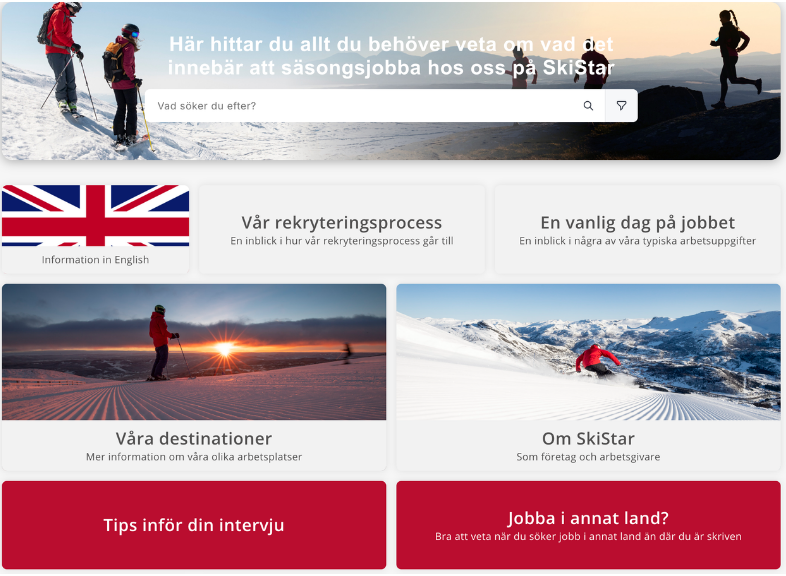
Read how SkiStar cut onboarding time in half for seasonal employees.
From recruitment to everyday support, one platform for the whole journey.
Frequently asked questions about onboarding with InfoCaption
Digital onboarding means that the onboarding process is supported fully or partly through digital tools, such as courses, guides, checklists, videos and interactive learning.
It helps make onboarding more structured, scalable and accessible, regardless of where the employee works. With InfoCaption, onboarding can also continue after the initial introduction, with guides, manuals and support available when questions arise in everyday work.
A good onboarding process should help new employees understand the organisation, their role and the practical work. It can include working methods, systems, procedures, responsibilities, culture, safety and other important information.
Onboarding should not be limited to the first few days. Some information is needed from day one, while other guidance becomes relevant later as the employee grows into the role.
Preboarding is what happens before a new employee starts, such as welcome information, practical preparations and materials sent before the first day.
Onboarding begins when the employee joins the organisation and continues as they settle into the role. It is about providing the right knowledge, context and support so the employee can work confidently and independently.
Read more about preboarding in our article.
Many onboarding platforms focus on the initial induction, with training, checklists and administration. InfoCaption combines structured onboarding courses with knowledge support that remains available in everyday work.
This means that knowledge is not only delivered at the start of onboarding. It can also be made available through searchable portals, manuals, guides and support connected to systems and workflows.
You can use InfoCaption to create and organise digital onboarding courses, guides, manuals, checklists and knowledge support in one platform.
The same content can be used in a course, published in a knowledge portal, connected to a process or made available as support in a system. This makes it easier to create a structured onboarding process without duplicating content.
To create onboarding for different roles, start with the knowledge that everyone needs and then add role-specific content for different teams, responsibilities or tasks.
In InfoCaption, you can structure onboarding content so the right employees get access to the right knowledge. This makes it possible to create a shared introduction while adapting the content to different roles, departments or target groups.
Yes. In InfoCaption, managers and HR can follow up on assigned courses, activities and results at individual or group level.
This makes it easier to see where new employees are in the onboarding process, identify where support may be needed and ensure that mandatory parts of the introduction have been completed.
Offboarding is the process that takes place when an employee leaves an organisation. It can include returning equipment, removing access rights, documenting knowledge, handing over tasks, and ensuring important procedures are followed.
A clear offboarding process reduces the risk of knowledge loss and helps create a safer, more structured transition for both the employee and the organisation.
Read more about offboarding in our blog post.